Today Apple unveiled a suite of new
features aimed at bringing education into the iPad era: the iBooks 2 app,
iBooks Author, textbooks in the iBookstore, and the iTunes U app. Accompanying
these new apps and upgrades is the iTunes 10.5.3 update, which
lets you take advantage of all the new features.
Apple has updated a lot of products to great effect over the years, but
somehow iTunes always comes up short whenever upgrades roll around.
iTunes Match
and Wi-Fi syncing, two features introduced with iTunes 10.5, are fantastic steps
in the right direction, severing our dependency on the easily misplaced USB
cable, as well as the need to constantly sync and update multiple devices so
they hold the same digital content.
For the most part, however, iTunes is a mess to look at, and a hassle to
navigate.
We know that 10.5.3 is an incremental iTunes update, but it got us thinking
about a few areas in drastic need of improvement. Here are our top three iTunes
gripes that we hope Apple will fix in iTunes 11.
A Messy Interface
There is a
lot going on in iTunes. It manages all sorts of different
media, from music, books, and TV shows to the apps on your iPhone, and the App
Store itself (in the desktop version). The media density is so rich, in fact,
each unique section in the iTunes Store requires its own full-fledged landing
page with highlighted and featured content to differentiate hot selections from
long-tail back catalogs. And then, of course, you’ve got your own library of
content to deal with. It’s a lot to parse through.
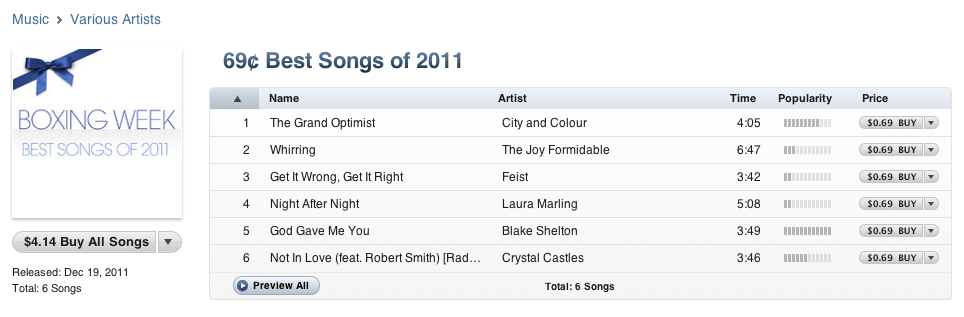
Even worse: The way iTunes is currently laid out is a mess. The App Store
landing page has 11 different sections of featured apps, and it seems there’s a
half-dozen ways to navigate to the very same pages.
We know Apple developers can create clean, intuitive interfaces — it’s, well,
what they do. Just look at the sublimely simple iOS interface, or the multitude
of Apple-built iOS and Mac apps that are straightforward and pleasant to use.
iTunes needs a major overhaul in usability, content discovery, and general,
overall simplicity. Banish those tiny icons! Give me a big, beautiful magazine
spread of content I have, and new stuff I can buy.
A Service No One Wants or Needs
Nobody uses Ping, Apple’s social network for music discovery, except for
(apparently) Phil Schiller.
Ping was a great idea. iTunes has more than 160 million
users, many of whom are dedicated music fans. Surely they would want to
communicate with each other, explore and discover new music with one another,
and interact with their favorite artists.
That was the intent of Ping, but the feature just didn’t click. Ping’s
Twitter integration is nice for finding friends and colleagues — assuming
they’re the sort of people whose music-buying habits you’d like to follow or
emulate. But artist involvement on the service is lackluster, and the lack of
Facebook integration has been a glaring omission. If Ping could mesh with our
Facebook likes and tap into our friend feeds, it might offer value. But
currently it’s just another sad example of another social network that never
was.
I’m sorry Ping, but it’s time to be quietly laid to rest — right next to
MobileMe.
Confusing Music Management
Overall, iTunes is a fantastic program for organizing and managing music, but
it does suffer significant problems in a few areas.
First, if you’ve got music tracks from a variety of sources — burned CDs,
purchased songs, Best Of albums — you’re bound to run into duplicate songs, and
it’s
a pain to recognize and
eliminate these dupes, especially if the versions are slightly different. It
would be great if iTunes could instantly recognize duplicates, and prompt users
with the option to delete the older or lower quality versions.
Second, iTunes (like most Apple products) doesn’t always play nice with
non-Apple-sanctioned content. Some users still have issues with iTunes not
recognizing songs that weren’t purchased from directly within the software.
These could be tracks burned from CDs, but saved in incompatible file formats or
bearing incompatible tag information. Offending files fail to transfer to iTunes
song libraries, or appear to transfer correctly, but don’t sync to attached
iPhones and iPods. Worst of all: When tracks fail to transfer or sync, iTunes
provides no explanation of what went wrong.
Third, users have issues with Apple’s iTunes
Match service, which launched in mid-November.
For songs that have counterparts that could be “matched” with existing iTunes
content, a number of users have found iTunes Match uploads the user’s version
rather than just using the matched version, making the upload process
excruciatingly long. Indeed, lengthy sync times are often cited as a major
complaint of iTunes in general.
iTunes is an incredible piece of software. Collecting your entire music,
video and apps library in a single place, and offering a dead-easy purchasing
platform, is no easy feat. But this is Apple we’re talking about, and we expect
much more from a company that’s built its reputation on interface simplicity and
“it just plain works” design.


.jpg?imgmax=800)


 11:38 AM
 Unknown





 Chinese
 French
 German
 Italian
 Japanese
 Korean
 Russian
 Spanish