Showing posts with label Panasonic. Show all posts

Wednesday, July 18, 2012

Panasonic Lumix LX7 is Announced


After the Long wait Panasonic Lumix LX7 its pocketable enthusiast compact camera. The LX7 features a slightly smaller sensor than the LX5, allowing it to offer the brightest lens of any compact camera with a really impressive F1.4-2.3 24-90mm equivalent range. The LX7 is based around a 10.1MP MOS sensor, rather than its predecessor's CCD, allowing it to offer 10 fps continuous shooting and 1080p60 movies (50p for European examples) in AVCHD Progressive format, or half that rate in MP4. It also gains an aperture ring around the lens, a 920k dot LCD, and finds room for stereo mics and a larger accessory port, allowing use with an optional high-res electronic viewfinder.

Source-Dpreview
 

Friday, March 2, 2012

Panasonic Eluga vs Sony Xperia S

We see if Panasonic's re-entry into the smartphone market, the Eluga, can compete with Sony's new Xperia S.
Form
Sony Xperia S - 128x64x10.6mm, 144g
Panasonic Eluga - 123x62x7.8mm, 103g
With the Eluga, Panasonic has opted for a sheer rectangular shape with very hard edges - it's not a far cry from the Lumia Nokia 800.
The back panel is smooth and curved and apart from a neatly squared camera port there's nothing to disrupt the stretch of premium-looking bodywork. The screen really dominates the front of the handset and the bezel round the edge is minimal.
The Eluga has a couple of nifty tricks up its sleeve also. For starters it has IP57 certification, which means it is both dust and water resistant, and it's actually waterproof up to a depth of 1 metre.
From the front the Xperia S actually looks remarkably similar to its opponent, the most noticeable differences, other than the branding, are the slightly softer corners and the idiosyncratic transparent bar at the bottom of Sony's device - which we rather like.
The back panel has a much more pronounced curve than the Panasonic Eluga and the outside edges are flatter.
Generally the Xperia S isn't anywhere near as curved as its predecessor, the Xperia Arc S, but it's also a much more solid device in terms of materials used, the build quality and how the handset sits in the hand.
While the Panasonic Eluga does look nice Sony has once again illustrated that it's capable of putting a more interesting spin on the status quo and for that reason we're giving this round to the Xperia S.
Winner - Sony Xperia S
Display
The Eluga features a 4.3-inch capacitive OLED touchscreen with a 960x540 pixel resolution, a pixel density of 256 pixels-per-inch (ppi) and multi-touch capability.
Sony's Xperia S has the same sized 4.3-inch glass front, which is an LED-backlit LCD capacitive number sporting a 1280x720 pixel resolution and an iPhone-beating 342ppi pixel density.
The Xperia S's display has a huge lead over most of the competition thanks to the spectacularly clear visuals it can push out.
Winner - Sony Xperia S
Storage
Panasonic's Eluga comes loaded with 8GB of built-in storage space and 1GB of RAM but sadly there isn't a card slot anywhere to be found on the device so you're not going to be able to bump it up with micro SD.
The Sony Xperia S has a much larger internal capacity at 32GB. Onboard RAM is the same as the Eluga at 1GB and there's also no card slot here.
A lack of micro SD is disappointing but Sony's handset wins out by having a lot more space on board.
Winner - Sony Xperia S

ProcessorThe Panasonic Eluga is equipped with a dual core 1GHz Texas Instruments OMAP 4430 processor based on ARM's Cortex-A9 architecture. It uses fast dual-channel memory, to make the most of both cores, and a PowerVR SGX540 graphics processor (GPU) clocked at 304MHz.
Sony's new Xpera S runs a dual core Qualcomm MSM8260 S3 Snapdragon processor clocked at 1.5GHz and paired with an Adreno 220 GPU. This setup features single-channel 333MHz/266MHz memory.
Both devices should give fast performance on the current crop of demanding apps and games but you might find things are a little zippier on the Panasonic Eluga's setup.
Winner - Panasonic Eluga
Operating System
Both phones will ship with Android 2.3 Gingerbread but with planned updates for Ice Cream Sandwich 4.0 at a later date.
This will be a welcome improvement, while both phones will currently run Gingerbread quite well, there should be a substantial performance boost with the new version as well as a number of useful features, such as an improved multi-tasking interface and a more streamlined menu system.
In any case, both devices will be on the same level at launch and after they update.
Winner - Draw
CameraPanasonic's handset has an 8-megapixel primary camera with a 3264x2448 pixel resolution, autofocus, LED flash, touch focus, geo-tagging, image stabilisation and a digital zoom.
Sony has really pushed the boat out with the Xperia S giving it a 12-megapixel primary with a 4000x3000 pixel resolution and the company's own Exmor R sensor technology.
Video capture is 1080p for the primary camera and features continuous autofocus, a video light and video stabilisation, while the secondary 1.3-megapixel camera can capture at 720p.
Other features include geo-tagging, autofocus, touch focus, a back-illuminated sensor (BSI), face and smile detection, image stabilisation and 3D panoramic sweep capture.
This is an easy win for Sony with a much more feature-packed camera setup which should also dish out better quality video and images thanks to Sony's premium sensor hardware.
Winner - Sony Xperia S
Final Thoughts
In most areas Sony's device wipes the floor with the Eluga, however the crucial point is the processor where Panasonic's handset comes out on top.
Not by a huge stretch though, which means we think as an overall package the Xperia S will probably prove a more rewarding experience.
That's not to say the Eluga is a bad device by any means, it's still a very competent smartphone with plenty to recommend.
We just think Sony's offering is a little more well-rounded.


Tuesday, February 21, 2012

Panasonic Corp. Launching New Smartphone


Panasonic Corp. (NYSE:PC) has rolled out its latest ultra-slim, stylish and high-specification waterproof smartphone code named Eluga in Europe.
The smartphone features ultra-slim D shaped design, 4.3 inch OLED QHD screen, 8MP autofocus camera, 1GHz dual-core processor, NFC technology and IP57 water and dustproofing.

Toshiya Matsumura, general manager for Mobile Communications at Panasonic Corp. (NYSE:PC), said, “Despite the unprecedented increase in the number of smartphone devices appearing over the last few years, we don’t believe anyone has yet managed to truly bridge the gap between style and substance. With the launch of the ELUGA, we’re aiming to prove it is possible to deliver style, function, form, and the very best underlying technology, all in a competitively-priced package”.

Friday, February 3, 2012

Panasonic forecasts record $10.24B

Panasonic is the latest Japanese TV manufacturer to feel the squeeze, and how — it's just updated its annual forecast to predict a loss of ¥780 billion ($10.24 billion), by far the largest in the company's history and coming close to the record ¥787.34 billion ($10.33 billion) loss Hitachi posted in the fiscal year ended March 2009. Like most other Japanese companies, Panasonic is blaming the strong yen and Thai flooding, although it also wrote off ¥250 billion ($3.28 billion) for the buyout of Sanyo in April. Its quarterly net loss was ¥197.6 billion ($2.59 billion), against average analyst predictions of just ¥3 billion ($39.37 million). Sony's disappointing results from yesterday suddenly look a little less disastrous, with Panasonic expecting to lose well over three times as much come the end of the fiscal year.

Tuesday, January 31, 2012

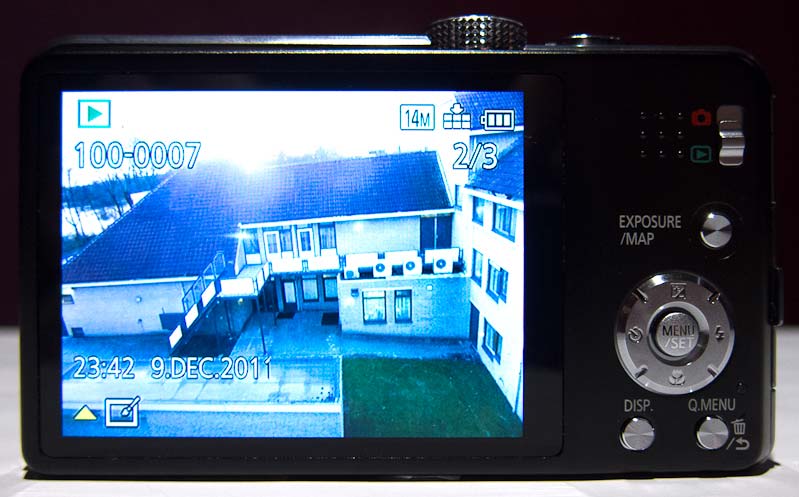
Panasonic TZ30, TZ25 Hands-On Photos

Want to see exactly what the new Panasonic TZ30 and TZ25 travel-zoom compact cameras look like in the flesh?
Then check out our extensive hands-on gallery of photos of Panasonic’s new travel zoom cameras.
 photos of the new Panasonic Lumix TZ30 and TZ25 compact cameras.

Image Gallery

Click on a thumbnail to see the full version.


Monday, January 16, 2012

Four new teleconverters unveiled for Lumix G-series cameras

Panasonic has unveiled four new teleconverters for use with their popular G-series range of mirrorless interchangeable compact system cameras. The four new conversion lenses are compatible with both the 14mm ‘pancake’ lens and the relatively new, premium-grade 14-42mm Lumix ‘X’ powered zoom. 
Lumix teleconverters 2
The first of the four is the DMW-GWC1 Wide Conversion Lens, which when mounted to the front of the 14mm pancake lens expands the field of view to 11mm – especially useful for architecture photography as well as group portraits in confined spaces.

The second new converter is the DMW-GTC1 Teleconverter, which increases the focal length of the Lumix X 14-42mm powered zoom by 2x, turning it into a 28-84mm lens.
Lumix teleconverters
The DMW-GMC1 Macro Conversion Lens is compatible with both the 14mm and the 14-42mm ‘X’ and reduces the minimum focal distance to 0.16m (as opposed to 0.26m on the 14-42mm, and 0.23m on the 14mm). It’ll doubtless appeal to macro enthusiasts.
 Lumix teleconverters 3
The fourth and final new converter is the DMW-GFC1 Fisheye Conversion Lens. Again, this is compatible with both lenses and extends a diagonal angle of view to 120-degrees. Small enough to fit inside a camera pouch it can be used to give images an interesting twist. 

Tuesday, January 10, 2012

Panasonic Lens Converters Convert Your Lenses

Tweak your Panasonic lenses with four screw-on adapters


Panasonic wants to save you a little money. Instead of having to buy a whole new lens just to make things look closer or further away, the company will now sell you a range of converters which will fit onto your existing lenses.
The four converters are as follows:
A wide angle which fits onto the 14mm (28 equivalent) Æ’2.5 prime, turning it into an 11mm (22mm) lens.
A telephoto converter which is compatible with the 14-42mm zoom and doubles its focal length, giving a maximum (equivalent) focal length of 168mm.
A macro adapter which fits onto both of the above lenses and lets them focus as close as 14cm (5.5 inches).
A fisheye converter which fits both lenses and gives a 120-degree angle of view.
These converters could prove very handy to keep in your camera bag, and although the prices and launch dates are still to be finalized, they should be a lot cheaper than buying whole new lenses. Or you could do what I do and pick up a converter that lets you mount Nikon (or other) lenses direct to your Micro Four Thirds body, giving access to a whole range of old, cheap glass.

Wednesday, December 21, 2011

Panasonic Lumix FZ48

The latest Lumix superzoom, the FZ48 or FZ47 if you’re based outside of the UK, adds to the stack of long-zoom compacts that have hit the shelves in recent months.
With a 24x optical zoom lens that ranges from a wide 25mm to a substantial 600mm the FZ48 is a straight continuation from the previous FZ45 model. In fact it looks very much the same from the outside, though there are a couple of significant changes beneath the exterior that see it as a step forward.

New sensor and HD video

First up the FZ48’s new 12.1MP CCD sensor is capable of higher transfer processing speeds than before which means a 1080i HD movie mode with a 17Mbps compression rate is possible. Both AVCHD capture and an MP4 file format straight from camera are possible and you can use the zoom while recording which makes for a well-rounded mode.
The faster sensor also pairs up with a faster autofocus system dubbed ‘Sonic Speed AF’ by Panasonic. While these marketing names can sometimes talk up even the subtlest of changes, the FZ48’s autofocus is a definite improvement that, when at the wide-angle settings, will see off even the sharpest of the competition. The caveat to that is when zooming in - the mid-tele stretch of the zoom isn’t nearly as fast to focus as at the wide end, though speed is still impressive overall.
Anyone familiar with the previous FZ45 model will note that it had a 14.1MP sensor, one that’s been ‘cut back’ for the latest FZ48 release in a bid to improve image quality overall. Put too many millions of pixels into a small space each of those sensor nodes will be fighting for good quality light, so balancing up a sensible resolution against decent quality is the goal here. Or so the theory goes.

Not a huge improvement

What may come as a surprise are the final results at full resolution - we were expecting big improvements but the results aren’t too different from the previous FZ45 model. Look for the finer details and the amount of processing causes edge distortion and a dwindling of detail.
Softness increases as the ISO setting goes up, but from ISO 400 and above there’s a notable drop off in sharpness that becomes very soft and blurred by the top-end ISO 1600 setting.
Although ISO 3200-6400 settings are available, these are reserved for specific modes only, and the final quality isn’t too good at all. While a raw mode was available in the FZ45 model it has been removed in the FZ48. Although the images are good enough due to good colour and exposure, they don’t outdo the competition and that’ll leave those seeking higher detail levels to seek an alternative -think Fuji HS20 with its Raw shooting and better processing.

The strengths of the superzoom

Without exception superzoom cameras compromise final image quality in order to deliver on the promise of a large lens in a respectively small body, so with that in mind there are many positives to be had from the FZ48.
The latest 3in, 460K-dot LCD screen sees a vast improvement over previous generations. Easy to view from a variety of steep angles, the level of detail is a step-up and images look very good indeed. To complement this is a 0.2in, 200K-dot electronic viewfinder that can be activated by hitting the ‘EVF/LCD’ button.

Although the viewfinder is small it’s still an essential tool for composing when bright sunlight gets to be too much, or when the added pressure of resting the camera against your eye gives additional stability for those long-zoom shots.
To further assist in keeping shots all the sharper is Panasonic’s ‘POWER OIS’ (optical image stabilisation) system that can counter shake by shifting an internal floating lens element by microscopic amounts. It’s a highly effective system and its benefits can be seen when composing images on screen in real time.

Great layout

The FZ48’s layout is top notch too. Whether a newbie or more seasoned shooter the positions of dials and quick menus make it easy to jump between options. Full auto (intelligent auto/iA) features alongside the usual manual modes, plus there’s an in-camera 3D mode that outputs MPO files.
A macro mode that can function as close as 1cm to subject is another fantastic feature - though any focal length beyond the widest 25mm setting will increase this distance (it becomes 1m from subject by the 600mm setting).
Some behind the scenes work has also seen Panasonic squeeze more power out of its rechargeable battery. Now able to tot up some 400 shots per charge – that’s a pretty good standing for a camera such as this.
Verdict:
The FZ48 has its positives: we’re fond of the fast autofocus system that, at the wide-angle settings at least, will see off much of the competition.
But it’s not all rosy: the 24x optical zoom, while more than sufficient for most users, doesn’t have the sort of reach that the Fuji HS20 or Canon SX30 IS can provide. Add to this that the FZ48’s latest 12.1MP sensor can’t step up image quality to a class-leading position - plus the Raw mode’s been culled, something available in the previous model - and it’s very much down to the fast autofocus and decent movie mode to deliver the sell.
Good though the FZ48 is, and worthy of a solid score for being a decent all-rounder, it can’t help but look a tiny bit tired in a highly competitive superzoom market.

Thursday, December 8, 2011

Panasonic confirms it will launch Android smartphones in Europe in 2012


Panasonic has confirmed that it will launch a range of Android-based smartphones in Europe next year, according to a company announcement.
The company is also planning to introduce devices in the US, China and other Asia markets, although at this stage no timeline for these launches has been given.
The new devices will be launched in March 2012, with the firm initially aiming to sell 1.5 million units in Europe by the end of the year. With plans afoot to launch in other global markets, Panasonic is expecting to sell 15 million smartphone worldwide in 2016; including 9 million across Europe, Asia, China and the US and six million (smart- and feature phone) sales in Japan.
While the company hasn’t revealed any confirmed details of its devices, it has revealed that it will be an ultra-slim D-shaped device, with a slim bezel to enable Quarter HD (QHD) viewing on a 4.3-inch large OLED screen.
The announcements comes after widespread rumours of the plans began circulating last month.
The company exited the European mobile market some time ago, although it continues to sell products in its native Japan.

 
Design by Free WordPress Themes | Bloggerized by Lasantha - Premium Blogger Themes | Blogger Templates